

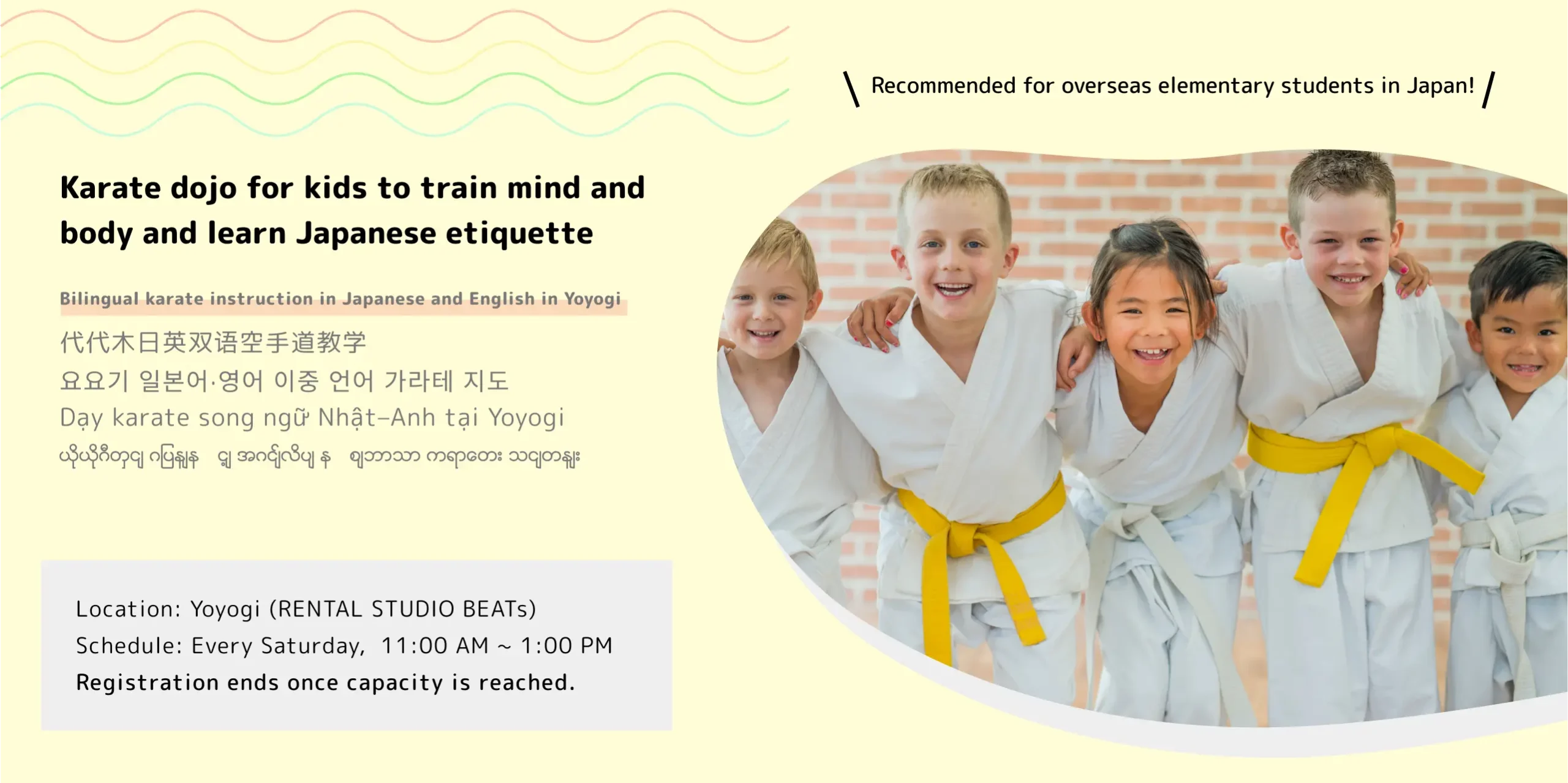
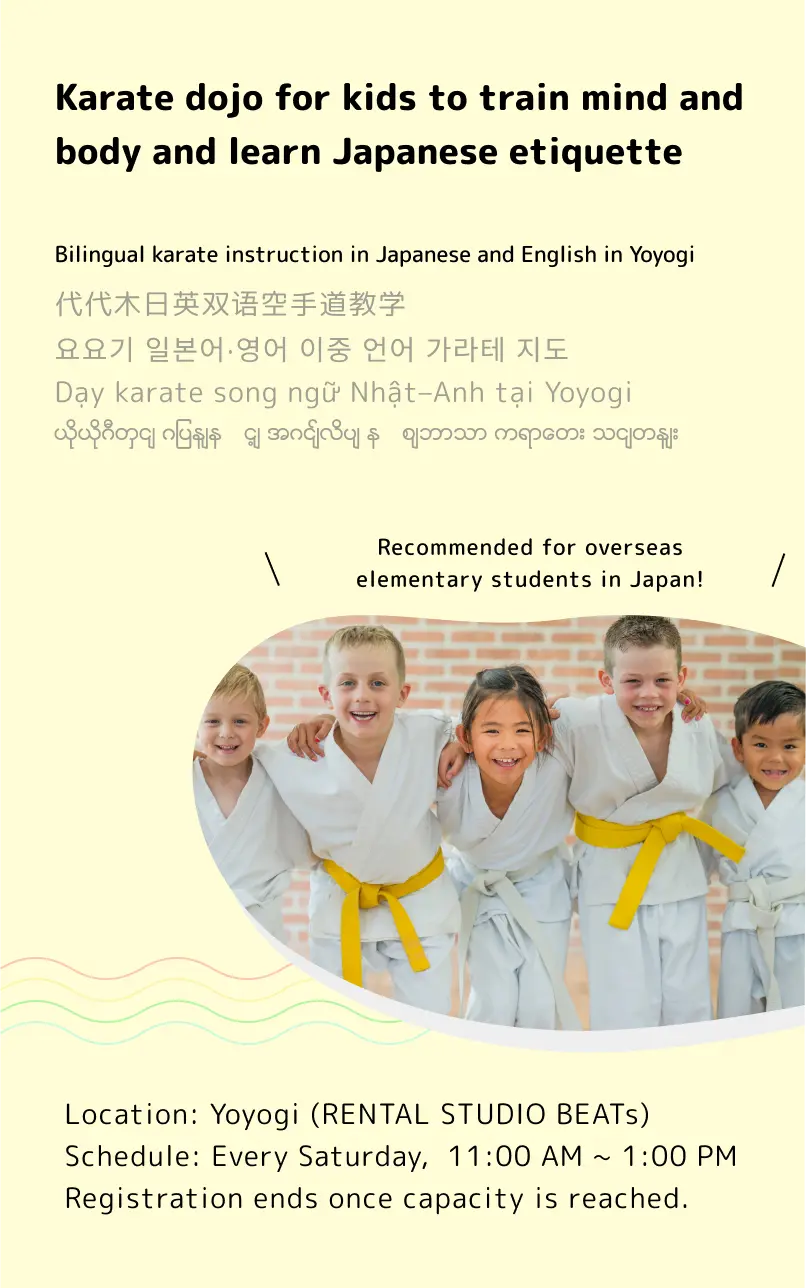
Only ¥1,500 per month! (¥4,850/year)
To children and parents
feeling anxious about life in Japan
We are the Japan branch of Shotokan Oshima Dojo, which has expanded to 16 countries around the world. Under the guidance of our Chief Instructor, Master Tsutomu Oshima, who introduced karate to the United States, we are an organization dedicated to pursuing practical karate as a true martial art.
At our dojo, we provide a place where children can grow with confidence through the traditional Japanese martial art of karate. Living in a foreign country can be a significant challenge for both children and their parents, and it is natural to feel anxious until becoming accustomed to a new environment, language, and culture.
Through our training, we not only develop physical strength and technical skills, but also cultivate important mental qualities such as courtesy, respect, and compassion. We hope to offer modest support so that your child can live with confidence and develop the spirit to take on new challenges.
This class is designed especially for elementary and junior high school students, where we carefully teach both the techniques and the spirit of karate. We warmly welcome both Japanese and international children to join us.
As the space in our dojo is limited, we are currently accepting only a small number of students. However, this allows us to provide careful, attentive, and high-quality instruction to each child.


Shotokan Ohshima Dojo Elementary
and Middle School Course
Our dojo is the Japan branch of Shoto-Kan Oshima Dojo, which has locations in more than 16 countries, including the United States. We practice traditional karate, which has also been featured as an Olympic sport, and we are proud to be part of a historically established karate organization.
The children’s program was created as an extension of our adult dojo.
In the Elementary & Junior High School Course, our goal is to help children strengthen both mind and body through karate and develop the ability to face challenges on their own.
*This course is available for children in grade 3 and above.
Four Features of Our Dojo
01
Learn Japanese etiquette
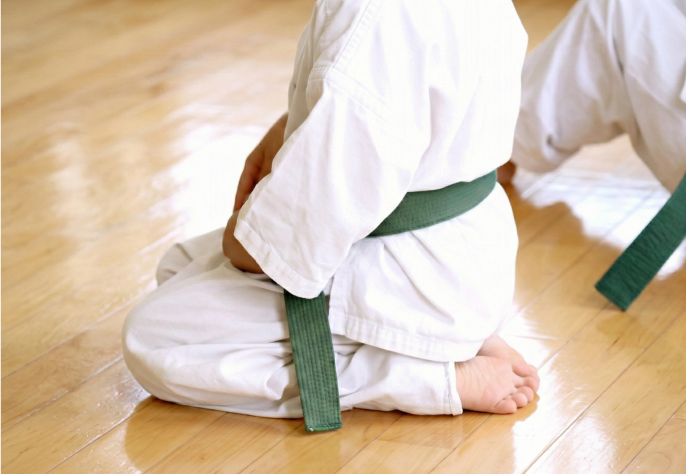
Gain a deep understanding of the long-valued etiquette in Japan, its meanings, and Japanese culture. By learning Japanese manners, you'll be able to truly understand Japanese society and its people.
02
Instruction in
Japanese and English
At our dojo, we actively engage with overseas sister dojos, and we have bilingual instructors who can speak both Japanese and English. Instructors who have lived abroad will be providing the instruction.
03
Traditional Karate for Self-Defense and Mental Discipline
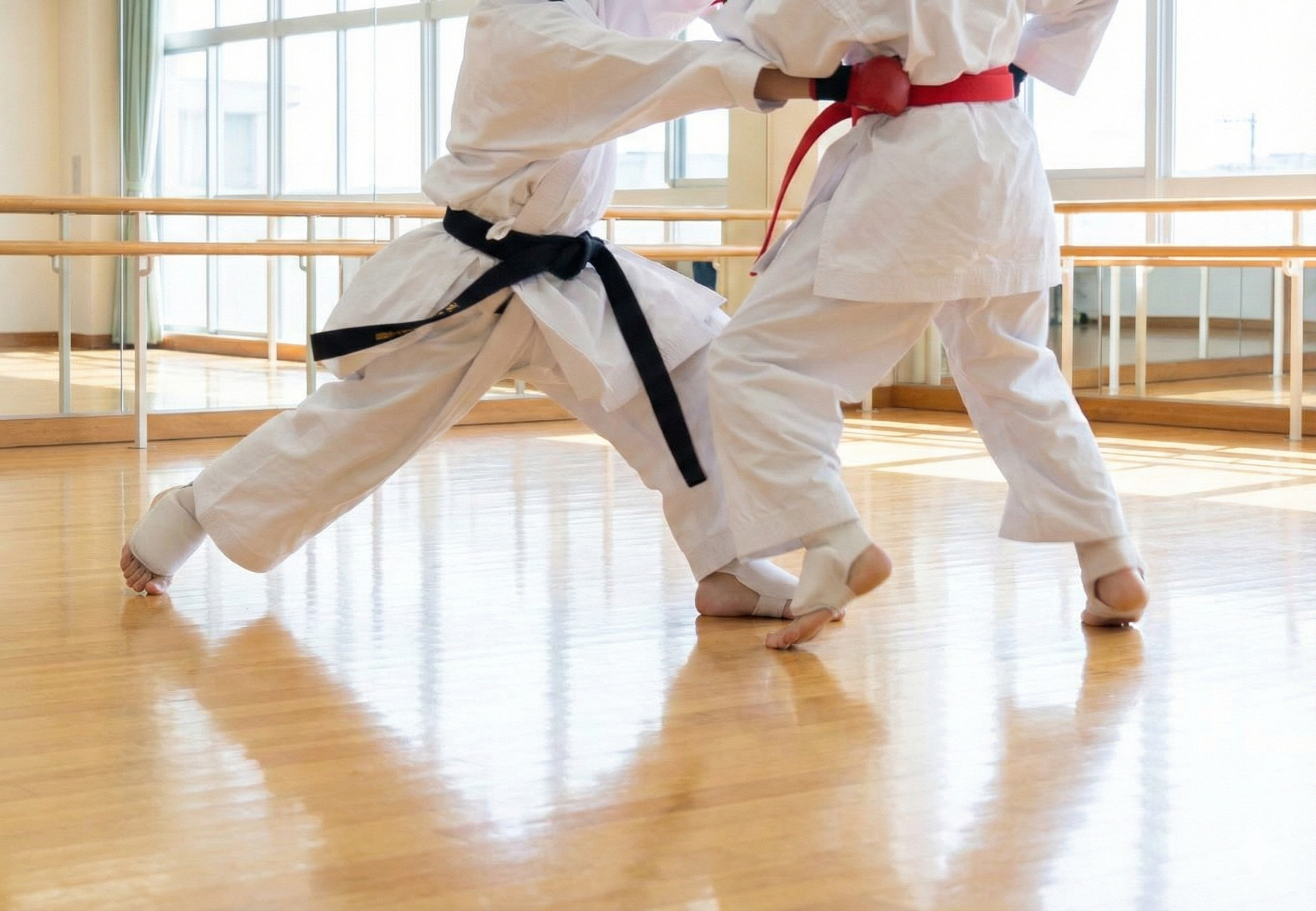
In karate, there is sport-focused training aimed at scoring points, and there is karate practiced as a true martial art. At our dojo, we do not focus solely on winning points at the expense of its essence. Instead, we remain committed to karate’s core principles—self-defense and the cultivation of mental strength.
04
Growth of Mind and Body
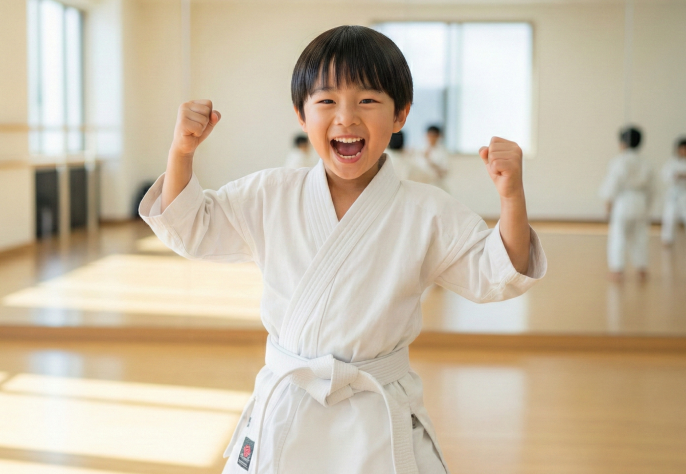
In karate, there is something called the 'spirit of budo' (martial arts spirit). The 'spirit of budo' means 'a strong mind that confronts difficulties without losing composure, no matter how critical the situation'. We believe that by cultivating the spirit of budo through karate, one can grow into a strong adult from within.
Reasons Why Martial Arts
Education is Being Chosen Now
Challenges Facing Children in Modern Society
In today's society, rapid digitalization and urbanization have significantly altered children's lives, leading to concerns about lack of exercise and declining communication skills. Additionally, as we move toward a multi-ethnic and multicultural society, there is an increasing need for the ability to understand and respect different cultures and values.
Multicultural Understanding and Mind-Body Growth Through Martial Arts
Against this backdrop, martial arts education that emphasizes physical and mental discipline and courtesy is gaining attention. Martial arts contribute not only to the improvement of physical strength and skills but also to mental growth and the development of self-management abilities. Furthermore, by learning traditional values, children can compare and understand their own culture and Japanese culture, fostering a spirit of respect for others with different backgrounds.
Changes in Your Child
from Learning Karate
Improved self-esteem
Through mastering techniques and learning etiquette, self-esteem improves. Skills that were initially difficult become achievable through repeated practice, allowing them to experience the sense of accomplishment that 'I can do it if I try.' Additionally, by challenging themselves in matches and promotion exams, they gain the joy and confidence of achieving goals. Learning polite behavior also earns them the trust of those around them, enabling your child to take pride in themselves.
Improved Language Skills
Being in an environment where instruction is given in both Japanese and English boosts language abilities. Through technical terms used during practice and everyday conversations, understanding of both languages naturally deepens. This leads to smoother communication at school and in daily life, enhancing adaptability in multicultural settings.
*This is not a school for learning Japanese.
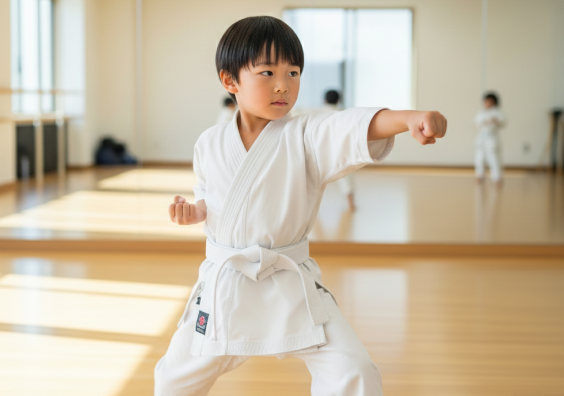
A healthy body
Through continuous exercise, physical strength and flexibility improve. Karate training uses the entire body, strengthening not only muscle strength and endurance but also balance and flexibility. By establishing regular exercise habits, a foundation for a healthy lifestyle is formed, greatly contributing to physical development during the growth period.
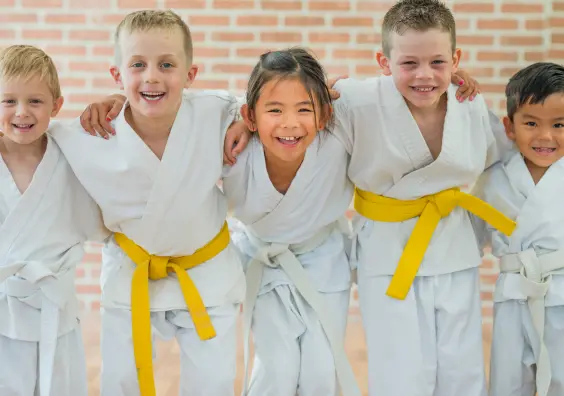
New friendships
By meeting peers who share common goals, your child nurtures social skills and cooperation. Furthermore, deepening friendships leads to the formation of communities outside of school, enriching your child's relationships. Additionally, interacting with friends from different cultural backgrounds helps them understand diversity and expand their international perspective.
Concerns about
your elementary or middle schooler?
- My child is struggling to get used to the Japanese language and culture.
- I feel they haven't developed social skills or manners.
- They lack self-confidence and aren't motivated to do anything.
- They're having trouble making friends in a new environment.
- I want them to develop concentration and perseverance.
Message from the Dojo Head
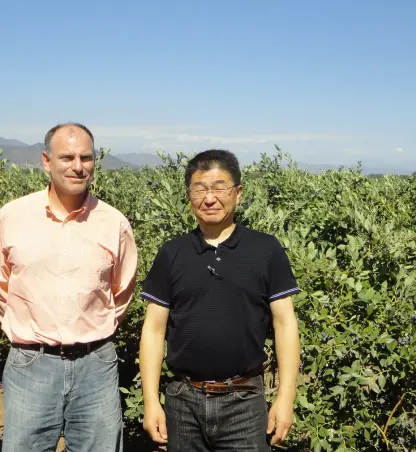
Dojo Head Satoshi Fukuda
Biography
After graduating from the School of Political Science and Economics at Waseda University, he obtained an MBA from California State University. He worked at the Zurich branch of a securities company and then re-entered employment at a private bank. In 1995, he became independent and, through UBI Corporation, imported food products from around the world to Japan.
In karate, he joined the historic Waseda University Karate Club during his time at Waseda University and has continued his training up to the present. He also served as a karate practical skills instructor at his alma mater, Waseda University, for seven years.
Training Policy
徹頭徹尾己に厳しく
Be thoroughly strict with oneself
彻头彻尾严格要求自己
철두철미하게 자신에게 엄격하라
Nghiêm khắc với bản thân từ đầu đến cuối
အစမ အဆုံးထိ ကိုယ်တိုင်ကို တင်းကျပ်စွာ ဆောင်ရွက်ပါ။
At our dojo, to foster children's independence and help them develop the mental strength to thrive in society, we have adopted "Be Thoroughly Strict with Oneself" as our training policy.
When people hear "Be Thoroughly Strict with Oneself," it may sound intimidating, but it does not mean forcing unreasonable demands.
In karate practice, by facing oneself and challenging personal limits, one can cultivate a sense of accomplishment and self-esteem. We believe this becomes the strength to overcome life's challenges and will surely have a positive impact on your child's future.
The Shotokan Ohshima Dojo with a global presence
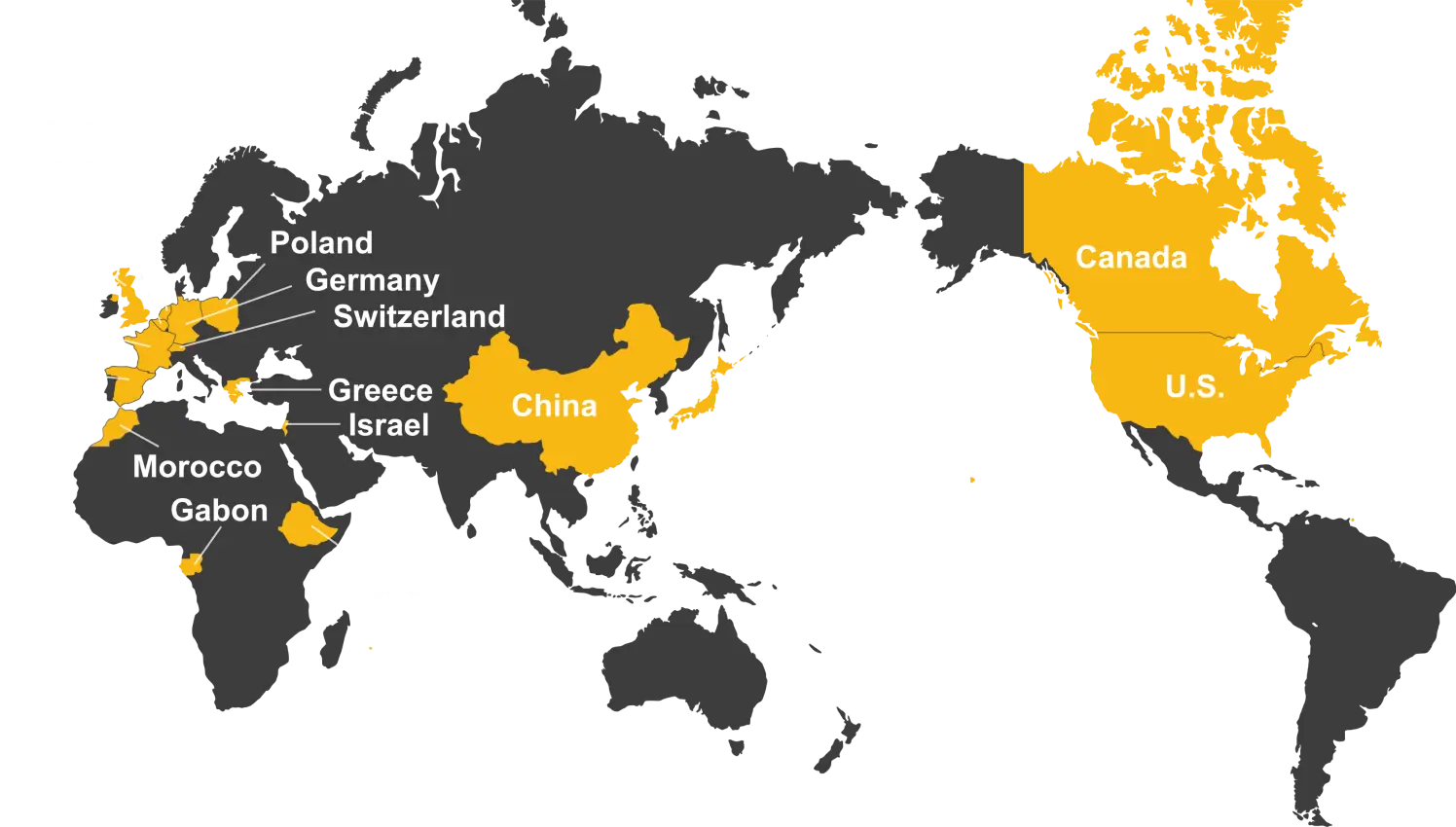
The Shotokan Ohshima Dojo has a global presence, with branches in 16 countries, including Israel, Switzerland, Canada, Spain, Belgium, Germany, Poland, Greece, the Netherlands, Curaçao, Morocco, Gabon, Hong Kong, and the United States. As the Japan branch of this international organization, our dojo frequently engages in exchanges and events with fellow dojo members from around the world.

US Shotokan
Established in 1956, the Ohshima Dojo has served as the heart of our organization, continuously evolving to this day. Grand Master Ohshima's base is also at the headquarters dojo in the United States. The headquarters, built in 2000 on a mountaintop in Santa Barbara, is a stunning and majestic location. Every time a commemorative event is held there, practitioners from around the world gather for joint training sessions.The headquarters maintains strong ties with Japan, and exchanges and training trips are frequent.

Canada Shotokan
Established in 1972, the dojo has produced many black belt practitioners over the years. Norman Welch, the President of Shotokan Canada, shares a close friendship with Yasunori Ono, the President of the Japan branch, fostering a long-standing relationship between the Canadian and Japanese dojos. Since the establishment of the Japan branch in 2009, the two branches have engaged in numerous exchange training sessions during each other's anniversary events, continuously enhancing their skills together.

Israel Shotokan
Established in 1970, the dojo has grown significantly, producing numerous dojos, members, and black belt practitioners. Eran Cohen, the President of Shotokan Israel, has a deep connection with Japan, having previously served as the Israeli Ambassador to Japan. He even established a dojo in Kōjimachi, which became one of the cornerstones of SODJ. To this day, Cohen spends half of each month in Japan, continuing to provide guidance. The relationship between the dojos in Japan and Israel remains strong, with frequent exchanges and events to celebrate anniversaries and further strengthen ties.
Training Location and Schedule
Training Location: A-studio, 2F Fuji Building, 1-42-2 Yoyogi, Shibuya-ku, Tokyo
(2 minutes on foot from Yoyogi Station)
Schedule: Every Saturday, 11:00 AM – 1:00 PM
About the Fees
Participation Fee
1,500 yen/time
Annual Fee
4,850 yen/year
* Includes sports insurance fee
Our dojo is currently
limited to 20 members
To ensure each individual receives adequate attention, we maintain a small class size, so the number of participants is limited. If there are many applicants, we may consider expanding our instructors and training locations, but we cannot accommodate additional members when full.
If you are interested, please contact us as soon as possible.
Frequently Asked Questions
Q.What is the minimum age to join?
A.Our children’s program is for ages 8 to 12 (3rd grade and above). Students aged 16 and older may join our adult classes instead. Please see the details here.
Q.Is karate painful?
A.Our dojo's karate uses controlled stopping techniques, so it is not painful.
However, even when attempting to stop, punches and kicks may still make contact.
As instructors, we carefully plan training sessions to minimize the risk of injury.
Q.Is a karate uniform necessary?
A.A karate uniform is not mandatory for training, but please wear one if possible.
It is required when participating in official tournaments.
If you do not have a karate uniform, please come to training in comfortable clothing that allows for easy movement.
Q.Can parents learn together with their children?
A.Parents cannot enroll in the children's class, but they can enroll in the adult class. Please consult us for more details.
Q.Does the Dojo Have Air Conditioning?
A.Yes, our dojo has air conditioning. We turn on the air conditioning during summer training sessions!
Q.Does the Dojo Have Bicycle or Car Parking?
A.No, our dojo does not have bicycle or car parking. Please use the nearby coin-operated parking facilities.
Important Notes for Participation
Persons Who Cannot Participate
- Individuals who have been advised by a doctor to refrain from physical activity.
- Individuals who may have contagious diseases that can be transmitted through exhaled breath, skin contact, or saliva.
- Individuals who engage in disruptive behavior towards other students.
Why not try a free trial first?
Explanations and trial sessions are free.
If you have any questions or would like to consult with us, please feel free to contact us.
Please be sure to contact us in advance and make a reservation.
Reservations are accepted on a first-come, first-served basis. If capacity is exceeded, we may not be able to accommodate you. Thank you for your understanding.